



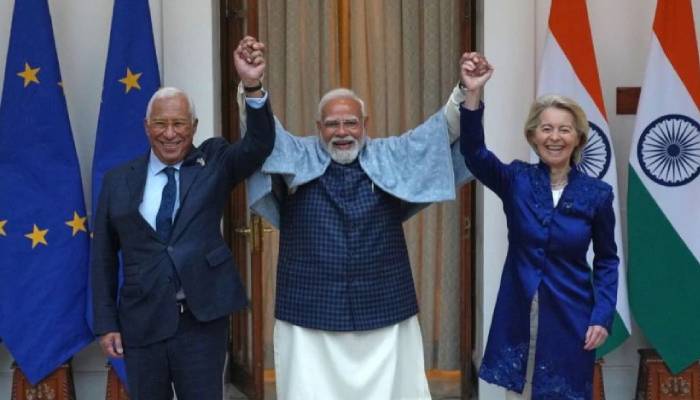
The Indo-EU FTA will boost Indian IT by easing market access, cutting regulatory friction, and opening new opportunities in Europe for services, talent, and digital trade.
By Manash Ranjan Debata (manash@accentinfomedia.com)
Trump’s tariff tantrums might be trumpeting across the globe but its cacophony is likely to lose its steam sooner than later. If the India–EU “Mother of All Deals”, the long-pending Free Trade Agreement, gets signed and implemented, it could prove to be a major accelerator for the Indian IT and tech services industry.
Breaking years of traditions, for the first time, two top officials from the EU, European Commission President Ursula von der Leyen and Antonio Costa, president of the European Council, graced India’s Republic Day Parade in Delhi as chief guests. Their visit assumes critical importance as India and the EU are all set to sign a trade deal. The seer declaration of it has started rolling the eye balls in major power corridors and soared temperature across the Atlantic amongst Trump and his arrogant MAGA brigade that are at the crux of the irrational tariff threats. After months of deliberations and hiccups, EU and India, both victims and targets of Trump’s tariff war, have decided to put down their differences and come to the table to form possibly the biggest ever trade block under one Free Trade Agreement.
The EU and India put together represent a significant economic block and account for over two billion people. The FTA will open new vistas for the Indian economy, in general, and the IT industry, in particular. Indian exports, which has been smarting under American Tariffs, will find new pastures in the EU. Similarly, the EU will be able to dissipate the US tariff threats and economic pressure by decoupling and deconcentrating its economy from the US by aligning itself with the rising economic power that is India.
For the benefit of our readers, we attempt to decode and deep dive into the various aspects of the Indo-EU trade deal, dubbed as the “Mother of all deals” by none other than Urusla Vonder Loyen herself.
So what tangible benefits will it bring for the Indian IT industry? Let’s go one by one:
First, the deal, once it comes into effect, will ensure easier market access for the IT industry, directly resulting in more EU business for Indian IT firms.
After the US market, the EU is already one of the largest clients for Indian IT. An FTA would likely reduce regulatory and compliance barriers; simplify cross-border service delivery. create clearer rules for digital trade. So you can expect more EU contracts for Indian IT majors such as TCS, Infosys, Wipro, HCL as well as other mid-size firms.
Second, the deal help smothen data flow & digital trade rules. This would be huge. One of the biggest pain points today is EU data protection laws (GDPR). Once the deal goest through, it will ensure data adequacy recognition for India and bring in clear rules on cross-border data flows. This would help Indian firms process EU data without complex workarounds. Besides, it will lower compliance costs and ensure faster project onboarding for Indian companies. This will directly boost cloud services, fintech, AI, SaaS, and BPO/KPO segments.
Indian IT lives and dies by onsite–offshore models. After the US virtually shut its doors on the back of Indian talent by tightening H1B visa rules, Europe could provide a reliable detour for Indian talent. Already, Indians account for 21 percent of Blue Card holders, which is the European equivalent of the US Green Card. The deal will further open the doors for top-notch Indian IT talent and researchers to fill in Europe’s acute talent deficit, further easing talent mobility and European visas. The FTA could ease short-term work visas; speed up intra-company transfers; and recognize professional qualifications. So what that means is a clear win for Indian IT. It would result in faster deployment of Indian engineers in Europe; better client engagement; and higher billing rates for Indian firms. This is especially big for Germany, France, Nordics, and Eastern Europe.
The deal would further boost India’s candidature as the the most preferred destination to Global Capability Centers (GCCs). Many EU companies are already setting up GCCs in India SAP, Siemens, Bosch, and BMW to name a few. With an FTA more EU firms will offshore R&D, cybersecurity, analytics, and AI work to India, transforming India into a strategic tech hub, not just a cost center. Thus, massive upside for IT services, product engineering, and deep-tech startups supplying EU corporates.
The deal will help Indian SMEs and Startups to get a real shot at Europe. Right now, Europe is tough for smaller Indian IT firms due to immense legal complexity; local presence requirements; and more important, compliance costs. An FTA could standardize rules; lower entry barriers; enable direct B2B digital services exports. This democratizes the EU market beyond just the top 5 IT giants.
The deal will bring in currency diversification, resulting in more stability – to some extent helping de-dollarization of global trade. Currently, Indian IT is heavily dependent on the US market. More EU business means less over-reliance on the dollar; and better hedging against US slowdowns or protectionism. Al these would result in long-term revenue stability for Indian IT.
The deal may result in long-term shift to high-value IT works. EU clients typically spend more on sustainability tech; Industry 4.0; Automotive software; and Green tech and compliance systems. This nudges Indian IT up the value chain, away from pure low-margin coding and support. This is going to be a paradigm shift in Indian IT.
Let’s have a look at the big picture. If properly negotiated and signed, the India-EU FTA could add billions in IT services exports; create high-skill jobs in India; and strengthen India’s position as a digital services powerhouse on a global scale.
However, there has to be one reality check. Often times, EU negotiations are slow and staggered. For Indian negotiators, data privacy and labor standards will be tough to overcome. In the same wavelength, there won’t be any overnight benefits. Benefits will be gradual, not overnight. It will take time to trickle down. So, be patient Indian IT!
