



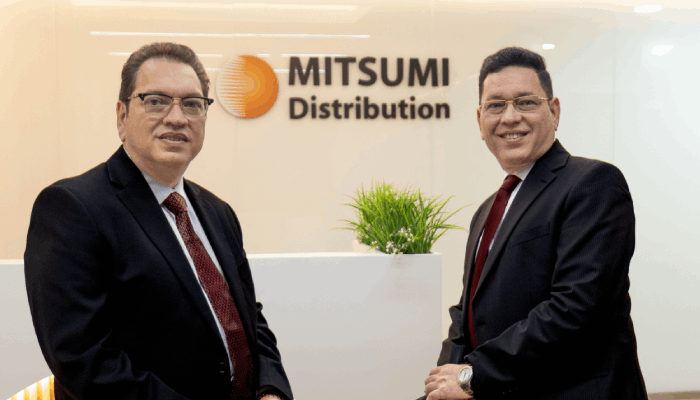
After establishing a substantial presence in MEA markets, MITSUMI’s foray into India isn’t merely a tactical move but driven by long-term strategic commitment to India’s technology ecosystem, leveraging the growing demand for trusted distribution partners amid a perceptible surge in IT spending and the rise of the digital economy
Founded by Jagat Shah, Chairman and CEO, who brings over 30 years of industry experience, MITSUMI Distribution is a prominent IT/Tech distributor and solutions provider headquartered in Dubai, UAE, with a significant global footprint. Amongst the company’s prominent leadership also includes Mitesh Shah, Founder and Managing Director and Rajveer Shah, Director and Head of the AI and Robotic wing.
Starting as an IT retailer in Kenya in 1998, MITSUMI Distribution has expanded its presence across Africa and the Middle East, evolving into a major player in the technology landscape by offering a wide range of services, including Business Development, Marketing, Logistics, Cloud services, AI, and Security Tools. The company also offers comprehensive Value Distributions, including Servers, Storage, Security, Cloud, Networking, and Software, as well as Volume Distributions of PCs, Printers, Peripherals, Telecom, Smartphones, Tablets, and Feature phones.
With an impressive global presence across 36+ countries, supported by 300+ employees and 30 warehouses, the company collaborates with over 45+ vendors and has a network of 3200 partners. They distribute a wide array of renowned brands, including Acer, ARC, ASUS, HP, Dell, Itel, Blackberry, LG, Lenovo, Samsung, VIVO, OPPO, NOKIA, Phillips, Canon, and Hitachi, etc. Beyond IT distribution, MITSUMI is also involved in Business Parks, Hotels, Housing Projects, and Shopping malls.

“Our ambition is for MITSUMI to become a household name among channel partners and technology vendors across India.”
-Jagat Shah, Chairman and CEO, MITSUMI Group
To get a clear snapshot of the action unfolding on the channel front inside this leading distributor, we spoke to the company’s maverick leaders Jagat Shah, Chairman and CEO, MITSUMI Group and Mitesh Shah, Founder and Managing Director, MITSUMI Group. Here is an edited excerpt from the interaction:
What made this the right moment for MITSUMI Distribution to enter India, and how does this move fit into your long-term global growth strategy?
Jagat: India is currently at the precipice of a defining moment where scale, aspiration and digitization are converging at an unprecedented pace. The thought behind our entry into the Indian market wasn’t merely tactical but a determined and long-term strategic commitment to India’s technology ecosystem. As a company that has deep Indian roots, this expansion is as much a homecoming as a growth move. We already have proven expertise handling the MEA region across 30+ countries, India was the next strategic pillar. India has a growing demand for trusted distribution partners with the rise of IT spending and the surge of the digital economy. That is where MITSUMI enters the conversation.
You’ve committed ₹700–1,000 crore for the Indian market—what are the top priorities for this investment in the first 18–24 months?
Mitesh: Over the next 18-24 months, our focus is on building a resilient and scalable foundation for our long-term growth in India. We have set this into motion by establishing 14 strategic locations to cover pan-India delivery, and three sales offices in Mumbai, Delhi and Bengaluru. The next phase will be expanding into Chennai, Kolkata, Hyderabad and Ahmedabad. Simultaneously, we are investing in strengthening inventory capabilities to ensure faster delivery and improved product availability across our entire distribution network. We have also implemented a local credit system for our channel partners, which leads to sustained, scalable growth.
This strategy has, at its crux, people and technology. We’re starting with an initial team of 30 members, with continuing investments in local talent as our vendor partnerships will expand. When it comes to technological investments, we are incorporating strong infrastructure, including advanced warehouse management systems and real-time shipment tracking for partners, ensuring transparency, efficiency, and scalability.
Our first transaction is targeted by early 2026 to establish operational momentum and market credibility. Overall, this investment is being allocated strategically across infrastructure, inventory, and local credit in roughly equal proportions. Our ultimate goal is to build one of the most robust and reliable distribution networks in the country, supported by systems and processes designed to scale efficiently as market penetration deepens. This approach ensures we are not just growing quickly, but growing sustainably and responsibly.
“Over the next 18-24 months, our focus is on building a resilient and scalable foundation for our long-term growth in India. We have set this into motion by establishing 14 strategic locations to cover pan-India delivery, and three sales offices in Mumbai, Delhi and Bengaluru. “
-Mitesh Shah, Founder and Managing Director, MITSUMI Group

India’s distribution landscape is highly competitive and fragmented—what gaps do you see that MITSUMI believes it can uniquely address?
Jagat: Traditionally, larger players tend to concentrate on Tier 1 markets, leaving Tier 3 and Tier 4 cities significantly underpenetrated. We see tremendous untapped potential in these regions and believe growth will increasingly be driven by smaller cities and emerging consumption hubs.
The market needs distribution partners who are quick to adjust to changing business requirements. Partners and brands frequently struggle with inconsistent execution and unclear intent in fragmented ecosystems. MITSUMI seeks to provide a long-term, transparent, and rigorous methodology that guarantees dependable partnerships and predictable results.
Beyond fundamental logistics, there’s a clear gap in comprehensive value addition. This includes rapid after-sales service, organized credit support, and adaptable, agile logistics models that can react instantly to changes in the market. Distributors need to have excellent multi-channel experience because firms nowadays operate across various channels, from system integrators and SMB partners to large-format retail and internet platforms. We are developing the capacity to concurrently and smoothly support each of these ecosystems.
Our ability to blend great local execution with worldwide best practices sets us apart even further. We are building a high-performance distribution engine powered by strong logistics, disciplined credit management, data-driven market intelligence, and intensive partner engagement, all supported by MITSUMI’s global experience.
Lastly, there is an urgent need to increase the accessibility and profitability of the newest mobile and IT technologies for all value chain participants. Our goal is to democratize access to innovation so that partners from all over the world can actively engage in the digital economy. This all-encompassing strategy enables us to facilitate growth throughout the ecosystem in addition to product distribution.
How will MITSUMI balance deep metro penetration with meaningful reach across Tier 2 and Tier 3 cities, where growth is accelerating?
Mitesh: Our plan is to strategically expand into high-growth Tier 2 and Tier 3 cities while constructing robust metro anchors. Our main metro hubs: Mumbai, Delhi, and Bengaluru, are where we started operating first. Expansion outside of metropolitan areas will be driven by demand, vendor relationships and market potential.
We will implement a hub-and-spoke logistics approach, with a 14-location network serving as regional hubs. This guarantees consistency, speed, and efficiency of service. Crucially, rather than trying to service them remotely from metropolitan areas, we will set up targeted local offices in smaller locations. This will enable us to establish more meaningful connections and react more quickly to the demands of the local market.
The MEA playbook saw us establishing an in-country presence in 30+ different markets. By building sustainable partner ecosystems (supported by local talent and cultural awareness) we are duplicating this approach in India, deploying gradually while maintaining server quality.
Our goal is to build a distribution network that accurately captures the richness and diversity of India across all market segments.
Channel partners often cite credit discipline and logistics as pain points—how is MITSUMI rethinking these elements for the Indian ecosystem?
Jagat: Instead of viewing disciplined credit as a necessary evil, we at MITSUMI view it as a fundamental competitive advantage. Our ₹700–1,000 crore investment is primarily focused on creating local credit facilities that support partner growth. We have effectively extended local credit in more than 30 locations throughout our MEA operations while conducting business in local currencies and upholding strict financial discipline. To guarantee long-term sustainability for all stakeholders, we are implementing the same strategy in India.
In terms of logistics, we have currently established a 14-location logistics network designed for faster reach, improved availability and operational efficiency. Technology plays a key role in this. To offer total transparency, we are putting in place advanced warehouse management tools, and real-time tracking. From import and warehousing to last-mile delivery, we are providing thorough logistical skills together with prompt after-sales assistance. For us, logistics and credit are not operational limitations but rather facilitators for partner success.
MITSUMI has a strong MEA footprint—what aspects of your MEA operating model are most relevant for India, and what will you localise differently?
Mitesh: Establishing an in-country presence, conducting business in local currency, and forming open, trustworthy partnerships through collaborative business planning are among our MEA strategy’s most pertinent assets. With specialized teams for transactional channels, retail, SMB, business, government, and education, our multi-segment operating model is quite transferable to India. Along with cutting-edge technology integration like AI-powered demand forecasting, route optimization, and smart warehousing, we also offer extensive logistical experience, as evidenced by our 100,000 square foot warehouse operations. Our disciplined credit strategy and our demonstrated ability to service more than 3,200 partners without channel conflict are key advantages.
But significant localization is needed in India. Given the magnitude of the population and the depth of the market, the scale is significantly larger. We are constructing a platform that captures the regional diversity and tiered structure of India. Compared to MEA markets, Tier 2 and Tier 3 cities are a much greater growth driver here. Additionally, we are navigating rules unique to India, such as GST and FDI policies, while utilizing our strong Indian heritage for execution that is culturally appropriate. We seek to modify partner engagement methods for India’s mixed traditional and digital-first enterprises, increasing smartphone penetration, and the rapid expansion of e-commerce.
How do you plan to onboard and scale vendor partnerships in India, especially in fast-evolving categories like mobility, cloud, and enterprise IT?
Mitesh: We are currently in advanced discussions with top PC, components, and peripheral brands with formal announcements coming soon. We have a tested and credible engagement strategy in the MEA region, with more than 40 international brands. Beyond this, we are expanding into cloud computing, enterprise software, mobility solutions, and artificial intelligence. We will give our partners across all tiers access to real-time market intelligence thanks to extensive, ground-level partner engagement. We have had a track record of achieving preferred partner status and we will continue that in India through cloud, AI, and value-added distribution capabilities. Focusing on fast-evolving categories will allow us to align with India’s digital transformation goals. We will build confidence in our vendors by demonstrating operational excellence and committing to market coverage.
What role do system integrators, large-format retailers, and e-commerce players play in your India strategy, and how do you avoid channel conflict?
Mitesh: Our approach to marketing is multi-channel by nature. We collaborate extensively with large-format retail, internet companies, SMB partners, and system integrators, all of which cater to different clientele. System integrators handle sophisticated solution deployments and enterprise infrastructure. SMB partners serve small and mid-market companies with regional ties. While internet platforms cater to geographically scattered and digital-first consumers, large-format retail drives consumer IT and mobility at scale.
We make sure that all stakeholders can profitably access the newest technologies. Clear support policies, upfront pricing, and well-defined rules of engagement all help to prevent channel conflict. Instead of competing in a zero-sum game, each channel is made to be profitable on its own. We have learned how to efficiently manage multi-channel ecosystems from our MEA experience with more than 3,200 partners across a variety of areas. Instead of competing for a fixed pie, we support shared value creation where all channels profit from market expansion.
As technology cycles shorten and margins tighten, how do you see the role of a modern distributor evolving in markets like India?
Jagat: Distributors need to go beyond logistics as margins tighten and technology cycles shorten. SMBs now have to deal with the same digital transformation challenges as big businesses, but many don’t have the resources or know-how to keep up.
By becoming partners in technology enablement, modern distributors close this gap. In order to assist partners to grow, function effectively, and optimize value, we are switching from transactional box-moving to a value-added distribution model. Integration of technology is crucial. Efficiency and responsiveness are increased via AI-driven demand forecasting, route optimization, and smart warehousing. Deep partner involvement and market information are now strategic assets. As working capital pressures increase, disciplined credit becomes a differentiator. Therefore, we are making investments in business growth assistance, technical enablement, and partner training. Stronger customer outcomes result from assisting partners in combining products into solutions as opposed to selling individual SKUs. Our aim is to connect ecosystems, support digital transformation journeys, and promote sustainable growth among partners, vendors, and end users.
Looking ahead five years, what would success in India look like for MITSUMI Distribution—scale, profitability, ecosystem impact, or all of the above?
Jagat: For us, success is comprehensive. Scale, profitability, and ecosystem influence describe it. With top-notch service from metropolitan areas to Tier 3 and Tier 4 cities, our goal is to become the distributor of choice, a leader in the mobile and IT sectors and be known as a reliable facilitator of India’s upcoming digital transformation. Our objective is to establish ourselves as the preferred partner for international technology companies looking to expand or enter India.
We will establish long-term competitive advantages in partner relationships, credit discipline, and logistics excellence. Strong ROI, increased market share, and steady profitability are all indicators of financial success. As our vendor and partner ecosystem grows nationally, we anticipate substantial organizational growth beyond our initial 30 employees. Above all we want to enable partners, provide market access, and democratize technology in order to make a significant contribution to ecosystem development. Our ambition is for MITSUMI to become a household name among channel partners and technology vendors across India.
